
Back Office ERP Software for Retail
Retail ERP software that runs catalog, inventory, GST billing and CRM in one back office
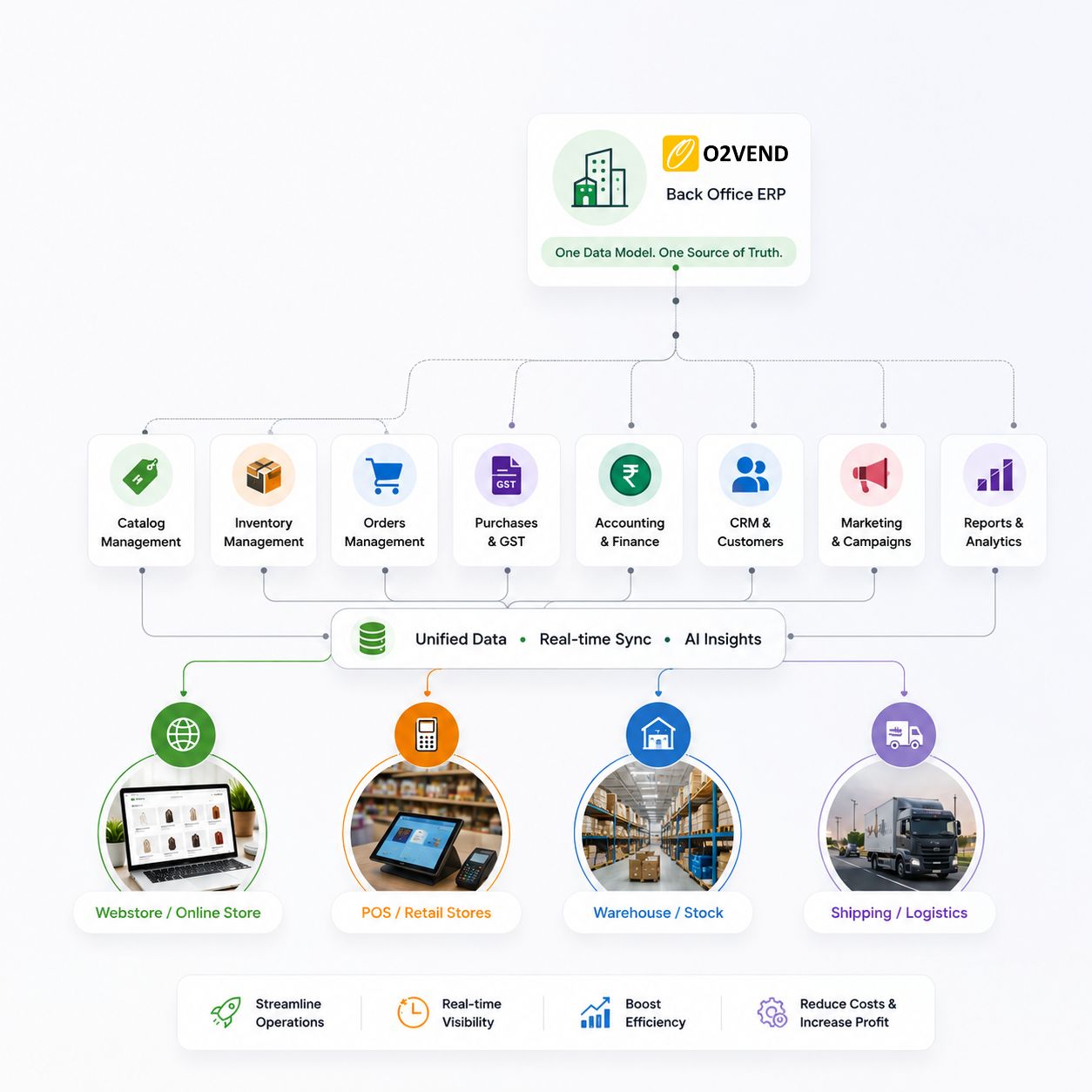
O2VEND Back Office is the operational hub of AI-native unified commerce. Catalog, inventory, CRM, orders, purchases, GST billing, accounting, marketing, and reports share one data model with your webstore, POS, and warehouse — so your team stops reconciling spreadsheets and starts selling.
Why a fragmented back office slows Indian retail down
Traditional retail ERP software was designed for manufacturing and finance-first workflows. Indian retail moves faster: new SKUs weekly, marketplace listings to maintain, GST-compliant invoices that must match what customers bought online and in-store, and store managers who need real-time stock truth before promising delivery.
When eCommerce, POS, warehouse management, CRM, and accounting software live in separate products, the back office becomes a reconciliation factory. Merchandisers update the catalog in one place; warehouse staff adjust stock in another; finance exports CSVs to Tally; marketing runs promotions blind to dead stock sitting in bins. Every handoff adds delay, error, and training cost.
Bolted-on ERP makes this worse. You pay for a finance suite, then pay integrators to connect it to Shopify, then add marketplace apps, then hire operations staff to babysit sync failures. Organic stores and FMCG brands feel this acutely — batch-aware inventory management, GST on mixed B2B and D2C sales, and high SKU counts cannot live in disconnected modules. Retail needs a unified back office ERP with AI agents that work on live retail data, not static reports.
Tool sprawl
What it is: Catalog, POS, WMS, CRM, GST, and accounting software in different logins. Why it matters: Integration cost grows faster than revenue. Who feels it: Founders and ops leads stitching systems together.
Reconciliation debt
What it is: Daily exports to match orders, stock, and invoices. Why it matters: Finance closes books late; ops trusts spreadsheets over systems. Users: Accounts and inventory controllers.
Listing lag
What it is: Products exist in the warehouse before they appear online. Why it matters: Lost sales and inconsistent channel catalogues. Users: Merchandisers and marketplace managers.
GST disconnected from sales
What it is: Tax handled in a tool that does not see live orders. Why it matters: Invoice mismatches and filing stress. Users: Store managers and CA teams.
Split customer records
What it is: Walk-in, web, and WhatsApp buyers treated as strangers. Why it matters: Loyalty and support lack context. Users: CRM and store staff.
Conflicting reports
What it is: HQ gets different numbers from web, POS, and accounting. Why it matters: Bad decisions on bad data. Users: Leadership and regional managers.
Why O2VEND Back Office ERP
ERP depth without the bolted-on mess — one unified commerce platform from catalog to cash.
O2VEND Back Office is not a separate finance product you integrate later. It is the operational layer of AI-native unified commerce: the same product record powers your website, POS terminals, warehouse bins, marketplace listings, purchase orders, GST invoices, and customer profiles. Change cost or stock once; every channel that should react, reacts.
That is the opposite of traditional retail ERP implementations — months of mapping fields between systems, nightly sync jobs, and staff trained on five different UIs. O2VEND is built for retailers, wholesalers, and D2C brands who sell across stores, web, and marketplaces daily. Accounting handoffs to Tally, Zoho Books, or QuickBooks stay clean because commercial documents originate from the same orders your team fulfilled.
AI agents sit inside this back office: the Catalog Agent drafts listings, the Inventory Agent flags shortages, the Marketing Agent proposes promotions tied to real stock, and the Finance Agent summarises anomalies — always with humans approving what goes live or to suppliers.
Data model for catalog through cash
Middleware between POS and web catalog
Invoicing aligned with daily sales
Agents on live retail data, not spreadsheets
Back office ERP modules — detailed
Every module shares inventory, customers, and orders with your storefront and POS.
Catalog management software AI-Powered
Purpose: manage products, variants, media, attributes, and channel publishing from a single product information backbone.
Inventory management software AI-Powered
Purpose: maintain multi-location stock, transfers, adjustments, and availability that every channel trusts.
CRM software for retail AI-Powered
Purpose: keep a single customer profile across walk-ins, web orders, and support conversations.
Order management system Core Module
Purpose: capture, edit, fulfil, and track orders from website, POS, marketplaces, and B2B portals.
Purchase order & procurement software Core Module
Purpose: raise POs, receive GRNs, and replenish warehouses and stores against real demand.
GST billing software AI-Powered
Purpose: apply tax correctly on invoices and prepare filing-friendly operational reports for Indian retail.
Accounting software integration AI-Powered
Purpose: keep commercial documents and exports aligned with what sold across channels.
Marketing & promotions engine AI-Powered
Purpose: run promotions, campaigns, and offers that respect real inventory and margins.
Reports & analytics dashboard AI-Powered
Purpose: sales, inventory, staff, and channel analytics in one place for HQ and store managers.
AI agents across back office operations
Agentic commerce inside ERP — agents draft and alert; your team approves.
Catalog & listings
Catalog Agent accelerates product publishing for high-SKU organic and FMCG ranges — descriptions and SEO fields ready for review.
Inventory & purchases
Inventory Agent connects purchasing decisions to movement data; fewer emergency POs before festivals and sale events.
CRM & support
Support Agent uses real order status and product context — critical when customers message on WhatsApp about delivery.
Marketing & promos
Marketing Agent ties campaigns to stock you need to move, not imaginary clearance lists.
Finance & GST review
Finance Agent highlights invoice and tax anomalies before month-end — humans confirm with CA workflows.
Analytics & ops
Analytics and Operations agents reduce dashboard hunting and silent fulfilment delays. Full agent detail on AI Agents.
How back office ERP works in unified commerce
One continuous flow — not a nightly sync between ERP and storefront.
Create products in catalog. Publish to eCommerce, POS, and marketplaces. Orders flow into one back office inbox. Warehouse picks and ships from shared inventory. Purchases and GRNs replenish stock. GST invoices reflect what sold. Accounting exports stay aligned. Reports and AI agents answer questions from the same truth — whether you run three stores or thirty.
Industries using O2VEND Back Office ERP
Fashion
Variants, seasons, and omnichannel catalog
Grocery
High SKU counts and daily ops
Jewellery
High-value orders and GST billing
Electronics
Accessories and multi-channel orders
Home decor
Showroom plus warehouse fulfilment
Organic stores
Batch-aware catalog and D2C
FMCG
Brand ops, dealers, and marketplaces
Retail chains
HQ control with store permissions
Integrations
Accounting, marketplaces, payments, and messaging extend the back office — they do not replace it.
Accounting
Tally, Zoho Books, QuickBooks — commercial exports aligned with orders and GST documents.
Marketplaces
Amazon, Flipkart, Myntra — orders and catalog tied to shared back office inventory.
Payments
Razorpay, PhonePe, Cashfree, Stripe — checkout and POS tenders feed order records.
Marketing channels
Meta, Google, WhatsApp, SMS, email — campaigns informed by CRM and stock reality.
Frequently asked questions
What is O2VEND Back Office ERP?
It is the operational hub of O2VEND's AI-native unified commerce platform — catalog, inventory, CRM, orders, purchases, GST, accounting, marketing, reports, and AI on one data model with eCommerce and POS.
Do I still need a separate ERP like a traditional finance suite?
Most retailers use O2VEND back office for day-to-day catalog, inventory, orders, GST billing, and operations, then export or integrate with Tally, Zoho Books, or QuickBooks as needed. You avoid bolting retail ops onto manufacturing ERP.
How is this different from Shopify plus apps?
Shopify optimises the storefront; you add ERP, POS, and WMS separately. O2VEND back office is native to unified commerce. Compare approaches on O2VEND vs Shopify or vs Zoho.
Is GST handled in back office?
Yes. GST-aware invoicing and operational tax reporting are part of everyday retail workflows online and in-store.
Does back office connect to POS and eCommerce?
Yes — they are the same platform. Catalog and inventory changes propagate without fragile middleware.
Can HQ control permissions by role?
Yes. Role-based access supports stores, warehouses, and HQ staff — discounts, voids, reports, and catalog edits as you configure.
Which modules are included?
Catalog, inventory, CRM, orders, purchases, GST, accounting, marketing, reports, and AI agents — depth varies by plan. See pricing.
Can organic and FMCG brands manage batch-aware inventory?
Yes. Inventory and warehouse modules support batch tracking for traceability and expiry-sensitive fulfilment alongside high-SKU catalog ops.
Can AI change my catalog without approval?
No. Agents draft and recommend; your team reviews and publishes customer-facing changes. See AI Agents.
Which industries use O2VEND back office?
Fashion, grocery, jewellery, electronics, home decor, organic stores, FMCG, wholesale, D2C brands, and multi-store retail chains.
Can wholesale and D2C share one back office?
Yes. One catalog with different price lists, customer groups, and fulfilment rules — common for brands scaling beyond pure D2C.
How do I get started?
Start free on Basic, or request a demo for multi-location rollout with purchases and GST workflows.
Simplify retail operations without bolting on another ERP
Start free today. Back office ERP, storefront, POS, and warehouse on one unified commerce platform.